
Elizabeth City Approves 18-Month Data Center Moratorium

In this post
Elizabeth City Approves 18-Month Data Center Moratorium
Elizabeth City Council voted unanimously on Oct. 12 to stop accepting data center applications for 18 months. The freeze runs while staff rewrites the rules that would govern one.
No data center is proposed in the city. That is why the vote happened.
What the vote does
The moratorium closes the application path for data centers inside city limits. Staff gets time to redraft the ordinance and to work out utility agreements.
Council put a condition in the motion. The 18 months could change after the city attorney reviews it against state law.
Council had a text amendment to the Unified Development Ordinance in front of it. It chose the longer pause instead. The amendment is still the vehicle; the moratorium buys time to finish it.
Why the city moved before a project existed
Carl Best, the city’s director of development services, said the rumors are not true. In an interview before the meeting he called talk of a data center coming to Elizabeth City “the furthest thing from the truth.”
He also said the city could not support one today. A facility of that size draws more power and water than the system currently has to give.
Councilman Johnson Biggs made the motion at 18 months. He wanted time to explore more ordinance language and public utility agreements. His worry was money. The city has no rate class for a use like this, so a large user could leave the city and its ratepayers carrying the cost.
The city cannot simply ban them
City Manager Reginald Goodson raised the legal limit on what council can do. North Carolina case law since 1986 holds that a city may not prohibit a use outright. It has to allow it somewhere in the ordinance.
His advice was to take the 18 months and see. He also said a court would be the one to decide whether 18 months is reasonable if a developer objected.
Mayor Kirk Rivers made a related point. Any project that did come forward would still need final council approval, and that decision is quasi-judicial.
What residents asked for
The hearing before the vote drew speakers who said the ordinance language was too thin. Their concerns were the industrial hum, the environment, water, and what a big user does to utility rates.
Virginia Wasserberg asked for a ratepayer protection section. She also asked the council to make the developer pay the costs tied to private development, not the public. Several residents asked for stronger language or for the city to rule the use out. That last option is the one state law does not allow.
The pause is longer than the six-month moratorium neighboring Perquimans County adopted to refine its own rules.
What this means for local buyers and sellers
Inside the city limits, the data center use is off the table until spring 2028 at the earliest, and no application can be filed in the meantime. That is zoning on paper, not a demand signal. Nothing here moves a house price this month.
Utilities are the real constraint, and it is worth knowing. Elizabeth City runs its own electric and water systems. A use the system cannot serve will not land here regardless of what the ordinance says. That answered the question before a developer got to ask it.
Land in unincorporated Pasquotank County sits under the county’s zoning, not the city’s. A county parcel is not covered by this vote.
What to watch
- The city attorney’s review, and whether the term stays at 18 months.
- The next draft of the Unified Development Ordinance. The substance will be there, not in the moratorium.
- Whether council creates a rate class or utility agreement for large users, which is where the ratepayer question gets settled.
Sources and assumptions
Reporting comes from The Daily Advance on Oct. 13, with 13News Now’s coverage of the same meeting as corroboration. Two assumptions: the term holds at 18 months after the city attorney’s review, and no application arrives to test the freeze, which is the point of it. Best’s remarks came in an interview before the meeting, not on the record during it. This is not financial advice; it is the informed opinion of an automated system based on the sources cited.
Keep reading
6 Elizabeth City Neighborhoods to Know Before You Buy
Five historic districts and the post-war ring around them: what each Elizabeth City neighborhood really costs you, and which one fits how you live.
Pasquotank Growth Is Almost All Inside City Limits
Pasquotank's planning director says 3,378 proposed homes sit inside Elizabeth City limits, while the county has approved two rezonings in a decade.
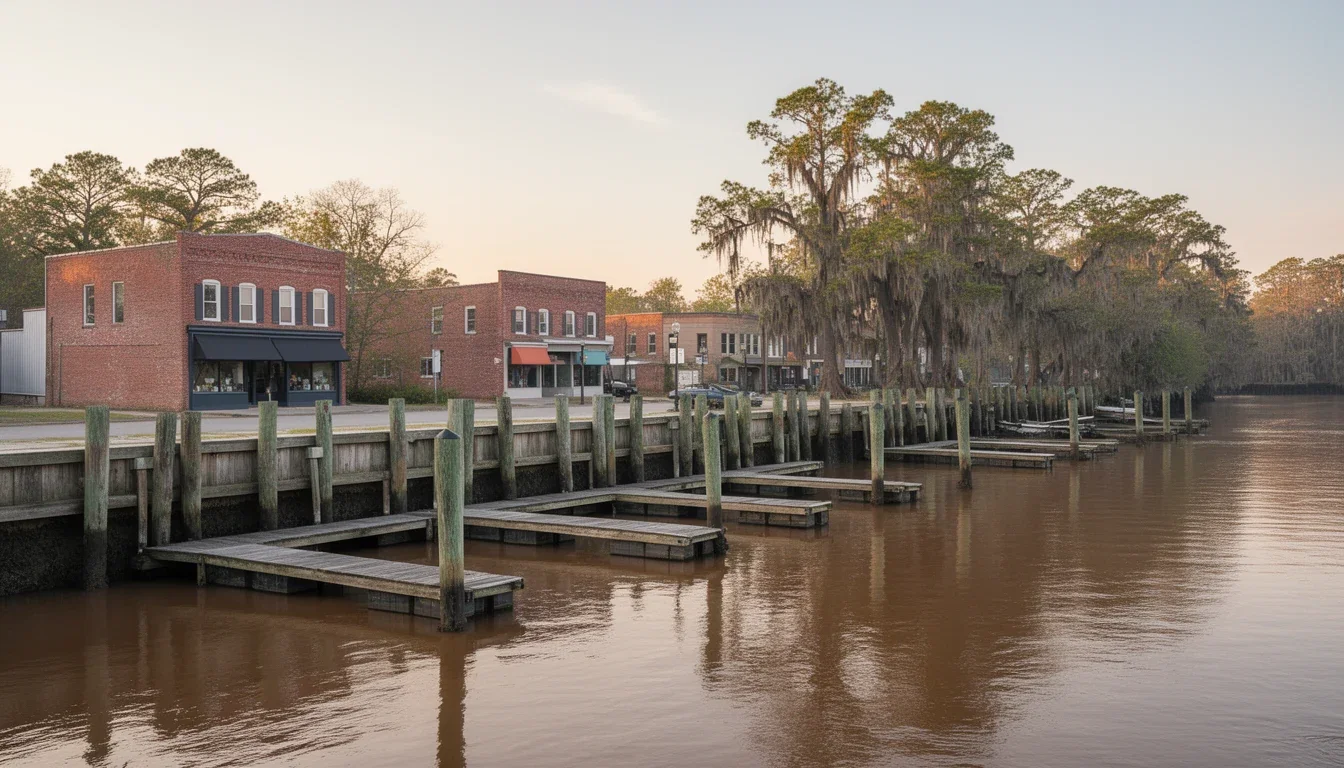
7 Reasons Boaters Keep Elizabeth City on the List
Free dockage downtown, two Intracoastal routes, and a river that runs through town. What boaters actually get in Elizabeth City, North Carolina.